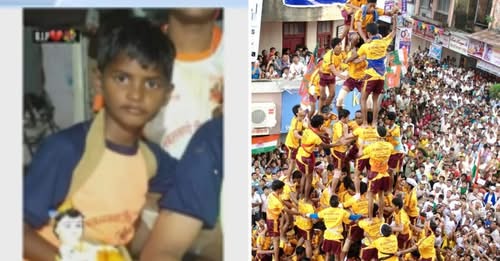
Mahesh Dadhav Death – The festive spirit of Mumbai’s Dahi Handi celebrations was overshadowed by tragedy when 11-year-old Mahesh Jadhav lost his life during a human pyramid practice session in Dahisar. The incident occurred on an open ground as local participants prepared for the annual festival, which commemorates Lord Krishna’s birth through the formation of tall human pyramids to break a suspended pot of curd or butter.
According to police reports, Mahesh fell from the pyramid during practice, sustaining a severe head injury. Witnesses immediately rushed him to a nearby hospital, but despite urgent medical attention, he succumbed to his injuries. The young boy’s sudden death has shocked the community, turning what is usually a time of joy into a moment of grief and reflection.
Authorities have confirmed that an FIR has been registered against Balaji alias Balu Ramesh Surnar, president of the organizing mandal. He faces charges of causing death by negligence and disobedience to public orders. The case has brought renewed scrutiny to the safety practices, or lack thereof, in such events. Investigations revealed that Mahesh was permitted to take part in the pyramid despite being only 11 years old—three years younger than the minimum legal age limit of 14 set by a Bombay High Court directive.
The court’s order, issued in response to previous accidents, was aimed at safeguarding young participants from dangerous heights and potential injuries. The guidelines also recommend strict enforcement of height limits for pyramids, the use of safety nets, adequate medical facilities on-site, and comprehensive training for participants. However, in Mahesh’s case, these measures appear to have been either ignored or inadequately implemented.
Local residents and safety advocates have voiced outrage over the incident, calling it a preventable tragedy. Many argue that while Dahi Handi holds deep cultural and religious significance, it must not come at the cost of human lives—especially those of children. “The law is clear, yet every year we see minors climbing to dangerous heights without proper safeguards,” said one community member. “This is not devotion; this is negligence.”
The accident has also reignited debates over whether Dahi Handi celebrations should be regulated more strictly or even curtailed when safety measures are not met. Several child rights groups are now pressing for mandatory safety inspections, mandatory use of protective gear such as helmets, and penalties for organizers who fail to comply.
For Mahesh’s grieving family, however, the debate offers little solace. Neighbors describe him as a cheerful and energetic boy with a passion for festivals and community gatherings. His untimely death is a painful reminder that joyous traditions can turn deadly when rules are ignored.
As investigations continue, authorities are expected to review enforcement mechanisms for the Bombay High Court’s guidelines to ensure that tragedies like this are not repeated. While Mumbai will continue to celebrate Dahi Handi in the years to come, Mahesh Jadhav’s death serves as a sobering call for reform—a reminder that cultural heritage must be preserved with responsibility, not recklessness.